IoT for Smart Automation: Building Connected Systems
Building Connected Systems
Build connected smart systems using ESP32 microcontrollers, automated sensors, and real-time environmental monitoring.
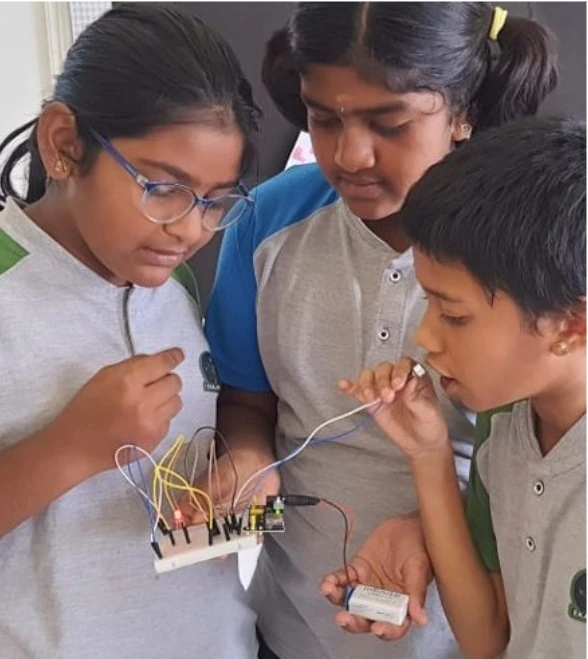
About this Workshop
This workshop is part of Creya Learning's Makers Day Out 101 Series, a collection of immersive, hands-on experiences that enables students to learn as creators, makers and problem-solvers. Each workshop combines technology, creativity, collaboration and reflection to help students turn ideas into meaningful solutions.
The IoT for Smart Automation workshop introduces students to how electronic components, sensors, microcontrollers and connectivity work together to create intelligent systems. Participants learn how a system senses a change in its environment, processes the information, makes a programmed decision and responds through an output device.
Students apply their learning to a real-world challenge connected to smart homes, energy conservation, safety or environmental monitoring. Through building, programming, testing and troubleshooting, they experience how connected technologies can automate tasks and respond intelligently to changing conditions.
Workshop at a Glance
Grades 7–12
4.5 hours without a scheduled break
Electronics exploration, two guided projects, one real-world challenge, testing and presentation
No prior electronics, programming or IoT experience is required
ESP32, sensors, electronic components, output devices and an accessible programming interface
Expected Impact & Student Takeaways
Workshop Schedule
Introduction to Electronics, IoT and Smart Automation
Explore how smart systems sense, process, communicate and act. Examine examples from smart homes, safety, energy conservation and environmental monitoring.
Meet the ESP32: Inputs, Decisions and Outputs
Become familiar with the ESP32, sensors, electronic components and output devices. Understand basic circuit connections and how a programme connects sensor data to an automated response.
Guided Project 1: Smart Alarm System
Connect a sensor and output device to create an alarm or alert system. Programme the ESP32 to detect a defined condition and respond through light, sound or another suitable output.
Guided Project 2: Sustainable Living Application
Build a system connected to energy conservation, responsible resource use or environmental monitoring. Read sensor data, define a threshold and programme an automated response or status indication.
Real-World Challenge: Understand and Plan
Receive a challenge connected to safety, smart homes, energy conservation or environmental monitoring. Identify the user and need, decide what the system must sense and how it should respond, select components and create a system-flow and build plan.
Team Challenge: Build, Programme and Test
Develop a working smart-automation prototype. Assemble the circuit, programme the control logic and test the system under different conditions. Troubleshoot and improve its reliability.
Prototype Showcase and Reflection
Core Learning Pillars
Electronics Foundations
Understand simple circuits, power, connections, inputs and outputs.
Sensors and Data
Explore how sensors detect light, temperature, moisture or motion.
Automation and Control
Build systems that respond when a defined threshold is reached.
IoT and Connectivity
See how connected devices communicate status updates or alerts.
Systems Thinking
Recognise how inputs, processing and outputs work together.
Testing and Troubleshooting
Find problems in circuits, sensor readings or programme logic.
Responsible Technology
Consider privacy, reliability, energy use and safety.
Collaboration and Communication
Plan, build, test and explain a solution as a team.
Student as Technology Creator
Use electronics and IoT to address real-world needs.
Why Participate?
Understand how sensors, microcontrollers, connectivity and output devices work together.
Programme a system to detect changing conditions, make decisions and respond automatically.
Explore how connected devices collect, process and communicate information.
Use conditions, thresholds, variables and outputs to control physical behaviour.
Create a system for safety, smart homes, energy conservation or environmental monitoring.
Identify and correct problems in circuits, sensors, connections, communication or code.
Recognise how sensing, processing, communication, output and user action influence one another.
Make technical decisions, divide responsibilities and build a shared solution.
Develop electronics, programming and problem-solving skills for future Robotics and IoT challenges.
Explore Other Workshops
Early Robotics
Grades 1–3Build moving robots with coding blocks and sensors, then tackle playful challenge courses through hands-on tinkering.
App Development (MIT App Inventor)
Grades 1–3 & Grades 4–6Design interactive mobile apps using visual blocks, buttons, and sounds to solve everyday problems as creators.
Design Thinking
Grades 4–6 & Grades 7–12Frame real-world community problems through user empathy, brainstorming, rapid prototyping, and iterative team testing.
Generative AI
Grades 4–6 & Grades 7–12Master prompt crafting and creative AI tools to generate rich stories, visual concepts, and interactive media responsibly.
Ready to Start Creating?
Join our Maker Workshops and turn your ideas into reality with hands-on projects and expert guidance.